
For The Skin I Live In trailer, click here.
Almodóvar’s The Skin I Live In as a Portrayal of Patriarchal Society
Pedro
Almodóvar’s cinematic productions are not exactly famous for their
family-friendly themes, their avoidance of disturbing visual representations,
or their subtle treatment of sexual violence, but his 2011 science-fiction psychological
thriller, The Skin I Live In is a
particularly extreme watch. The story was inspired by Thierry Jonquet’s 1984
novel, Tarantula, but was given a
rather Almodóvarian edge to it by the Spanish filmmaker, who worked as both the
writer and director of the film released in 2011. By telling the quite twisted revenge
story of a plastic surgeon played by his long-time collaborator, Antonio
Banderas, Almodóvar appears to problematise the working mechanisms of
patriarchal societies including the maniacal struggle for control and the
desperate attempts to maintain the social structures that ensure male dominance.
The
film is set in the Spanish city of Toledo, mostly in the enormous mansion of Dr
Robert Ledgard (Antonio Banderas), who turns out to be a rather Frankensteinian
take on the well-known trope of the mad scientist who goes beyond all ethical
boundaries. He has successfully cultivated an artificial skin called GAL that
is resistant to fire as well as insect bites, however, the medical symposium
forbids him to continue his research as a result of his illegal transgenic
experiments on humans, which makes him retire to his fortress-like estate to go
on with his undertaking in secret. As viewers later find out, Ledgard’s
obsession with the shield-like skin is a result of his past trauma involving
his wife, Gal, who was almost burnt to death in a car accident and committed
suicide when she saw the reflection of her distorted face in the window.
Ledgard’s project and his choice to name it after his deceased wife clearly indicate
the unresolved issues of the past lurking both in the back of the surgeon’s
mind and in the unconscious of the film itself.
The
other main character in the story is Vera Cruz (Elena Anaya), who, for the
first half of the film is shown to be a beautiful young woman kept as prisoner
in Ledgard’s secluded estate, used by the man as the guinea pig of his dermatological
experiments. The house is presented as a magnificent prison for Vera, with a
surveillance system that monitors her every move through various screens. It
appears that Vera and Ledgard are involved in an affair, since they are shown
to sleep together at times, though unsuccessfully, as it causes Vera excruciating
pain to have sex with him. During one of these nights, they fall asleep and the
camera zooms in, first on Ledgard’s face and then on Vera’s, to draw the
viewers into the past, showing their separate experiences from the same night 6
years ago and the events that occurred since then. Ledgard’s dream introduces his
mentally unstable adolescent daughter, Norma (Blanca Suárez), who is on
medication for psychosis stemming from witnessing her mother’s aforementioned suicide
as a child. In his dream, Ledgard and his daughter are at a friend’s birthday
party, during which Norma suddenly disappears, and when Ledgard goes to look
for her, he finds her lying in the garden, unconscious. When woken up by her
father, she starts screaming and fighting, as she believes that Ledgard has
raped her, which fixation leads to her spending years in a mental health
facility, where she finally commits suicide in the same way her mother did
years ago.
The twist
in the plot comes when Vera’s point of view is presented through her dream, and
that is when the film becomes a revenge narrative as well, since it reveals
that Vera is actually Vicente (Jan Cornet), the young man from the party who sexually
assaulted Norma in the garden, and who was therefore hunted down by Ledgard and
put through a vaginoplasty as well as a complete gender-reassignment to eventually
look like the surgeon’s late wife, Gal. As expected from an Almodóvar production,
violence does not stop there. A further rape scene takes place in the present,
in which Vicente is no longer the perpetrator, but becomes the victim of the
act. While Ledgard is away one day, the son of his housekeeper, the petty
criminal Zeca (Roberto Álamo) comes to the estate, uninvited, and notices Vera (Vicente
in a woman’s body) in her room through one of the screens. Mistaking her for Ledgard’s
wife and his former lover, Gal, Zeca rapes her. When Ledgard arrives home and finds
them, he shoots Zeca. While cleaning up the mess, Ledgard’s housekeeper
discloses to Vera that both Zeca and Ledgard are her sons, although from
different fathers, and that they both fell for the same woman, Gal, who was
actually running away with Zeca when the fatal car crash happened. The mother also
discloses the extraordinary similarity between Vera and Gal, which somewhat explains
the two men’s reactions and the events of that day. After this incident, Vera
appears to have accepted her fate to live as a woman and become Ledgard’s
lover, but Almodóvar does not fail to surprise his viewers with a final twist
in the plot—one that the resolute enthusiasts of his work or this genre might
foresee—during which Vera, or rather, Vicente kills both Ledgard and the
housekeeper and returns home to reunite with his mother after six years of
captivity.
As it is
already visible from the above plot description, The Skin I Live In is a highly complex piece of cinema that
incorporates absorbing themes—including voyeurism, gendered (sexual) violence,
forced gender-reassignment, misogyny, God-complex, toxic masculinity, etc.—allowing
for a great variety of interpretations. Nevertheless, the problematisation of male
authority as well as sexual violence seem to be reappearing subject matters in the
Almodóvar-oeuvre, from which rule Skin
is no exception. The notion of male dominance over women appears to permeate
the whole film, one symptom of which is the visual representation of women’s
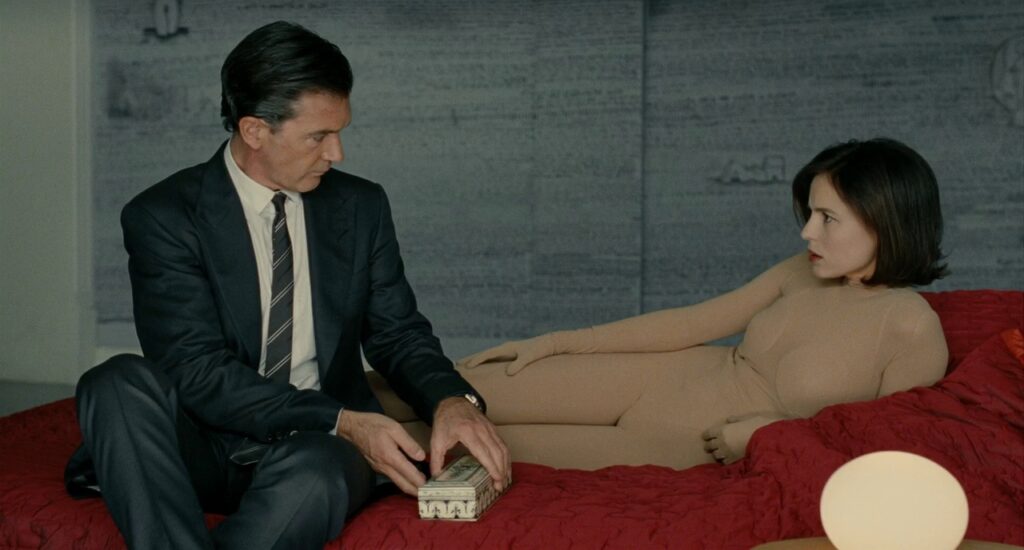
body as mellow and malleable. Ledgard’s home is full of artworks portraying the
idealised vision of the naked female form, including two paintings of Venus,
while his laboratory contains a life-size mannequin which he uses as Vera’s
double for the development of his new kind of skin. The shots of these art
pieces and the mannequin are skilfully aligned with images of Vera on Ledgard’s
enormous television screen, resting in similar postures as these oversexualised
depictions, which stylistic choice makes it clear that the surgeon sees little
difference between the women on his walls, the three-dimensional model on his laboratory
table, and the real human being in the room upstairs. Accordingly, Vera can be
perceived as Ledgard’s Venus, his “masterpiece,” that he created to be the
living replica of his dead wife, that is, the female body he can possess. Ledgard’s
act of bringing Vicente under his control and reshaping him to Vera seems to be
an attempt to erase the loss of confidence and masculinity caused by his wife’s
unfaithfulness and to try and rebuild his damaged position as the patriarch of
the household. Therefore, all these representations exist in his house both as symptoms
of his trauma and as reminders of his resulting obsession with modelling and
controlling women—clearly recalling the psychopathology of the archetypal mad
doctors of cinema.
Ledgard’s
house can be seen not only as an artist studio but the very materialisation of
the surgeon’s deranged psyche. Firstly, the interior design of the building is
a strong indicator of Ledgard’s paranoia about the vulnerability of skin and of
the trauma it is rooted in. One would expect clear-cut surfaces and sharp forms
when stepping into a surgeon’s home instead of the smooth, curved, often even
globular pieces of furniture and decoration that the filmmaker decided to equip
Ledgard’s house with. However, Almodóvar’s choice in design is no coincidence: the
overstated avoidance of pointed, sharp edges can be the subtle manifestation of
Ledgard’s fear that once again, he will lose the idealised woman existing in
his head. Moreover, the element that Ledgard’s laboratory in the basement is
fortified by thick brick walls and an art glass enclosure further emphasises
his deep-rooted anxiety of being deprived of his intellectual and material
possessions including Vera, who fundamentally falls into both of these
categories.
Finally,
similarly to the case of pathological male figures in other Almodóvar films
like Talk to Her (2002), voyeurism is
an unequivocal sign of Ledgard’s mania as well, which the house is basically
the centre of. It is evident from his behaviour that the cameras watching Vera
are not solely for the sake of monitoring her as his guinea pig and quasi
prisoner, but he also takes pleasure in peeping on her, longingly staring at
her body on a gigantic screen, believing that Vera does not suspect this habit.
It is important that he intends to do this in secret, which also supports the
idea that he does this for his own pleasure and not as a security measure, in which
case he would most probably want Vera to know about her being watched. Thus, by
creating a skin that cannot be hurt by fire, surrounding Vera with unharmful
objects, and locking her up while watching her every move in order, on the one
hand, to make sure she never repeats Gal’s fatal step of running away with
someone else and, on the other hand, to take pleasure in being the only male
gaze she is exposed to, the doctor is basically shielding his own fragile ego
he has been carefully rebuilding for the past twelve years.
In
this context, Ledgard’s taking revenge on Vicente for assaulting his daughter seems
to be more about reclaiming his own power as the patriarch in the social
structures of marriage and parenthood than about protecting Norma’s honour. Vicente’s
abuse towards Norma becomes an opportunity for the surgeon to rebuild the
structures that he lost due to other men’s violence: by making the young man
basically become his wife, he not only avenges his daughter as the honourable
father, but also re-establishes a way of life in which his “wife’s” sexuality
is exclusively centred around him. Should he really concentrated on Norma’s
well-being, he might not have started an affair and built up a whole life with
the man who hurt her. In fact, his move to force Vicente into a female body has
a rather misogynistic tone, since his tactic is basically about “diminishing”
the attacker into a woman, an observable possession, so that he can sustain
gendered sexual violence by a man—following a pattern that his own daughter has
also fallen victim of.
Nevertheless,
the problematisation of consent is probably the most disturbing aspect of
sexual violence in Almodóvar’s thriller. Both in the case of the assault of
Norma and the rape of Vera, the actual violence is presented as the result of a
misunderstanding between victim and perpetrator. It is clear from the beginning
that the child-like, medicated, and certainly unexperienced Norma is mistaken
for a spoilt rich rebel by Vicente, who is under the influence of drugs himself
that night, and who wishfully interprets the girl’s every move as flirting. Also,
even in the extremely violent attack of Vera, there is the element of doubt,
since Vera plays along when Zeca mistakes her for Gal—hoping that the man will
help her escape from Ledgard’s house—never revealing the reality to Zeca. While
the film is quite quick to pass judgement on Zeca, eliminating him in a few
seconds, it feels like Almodóvar tries to make the viewer feel pity for Vicente—who
has to go through horrible physical and mental abuse as a result of his act—playing
on the detail that, being drugged, he did not really understand the situation with
Norma. Being the witness of sexual violence is a shocking experience in itself,
but being put into the position of the judge by the filmmaker, who presents the
circumstances of the assault as blurry is even more disturbing. Although the
blamelessness of the victims should under no circumstances be a topic of debate,
the complexity of these scenes regarding consent adds a further layer of uneasiness
to the already unsettling atmosphere—in the creation of which Almodóvar is a
true expert.
To
conclude, The Skin I Live In can be
read as a pretty unique commentary on the psychopathology of the patriarchal mindset,
according to which men shape women for their own purposes, while falling in
love with an image that they have created themselves. Antonio Banderas does a
brilliant job in selling Ledgard’s character as the double-faced mad scientist,
who appears to be an exceptionally intelligent and highly respected surgeon on
the surface, but who slowly metamorphoses into the ultimate villain during the
course of the film. Thus, he turns out to be a megalomaniac aggressor, whose
true aim is to reclaim and maintain his position within the hierarchical
structure of the family. Although the figure of the deranged scientist is a
pretty overused one, the familiar duo of Almodóvar and Banderas manages to endow
it with less explored layers of this trope, making the cinematic experience a
necessarily ambivalent and disturbing one. While Skin is already worth watching solely for its use of visual effects—such
as its exceptional colour scheme reminiscent of Hitchcock’s films—and the
exquisite music that reinforces the action, a trigger warning is also in order,
since the film might not be suitable for topic-sensitive audiences due to the graphic
violence that is a structural element of this world.
Nincsenek megjegyzések:
Megjegyzés küldése